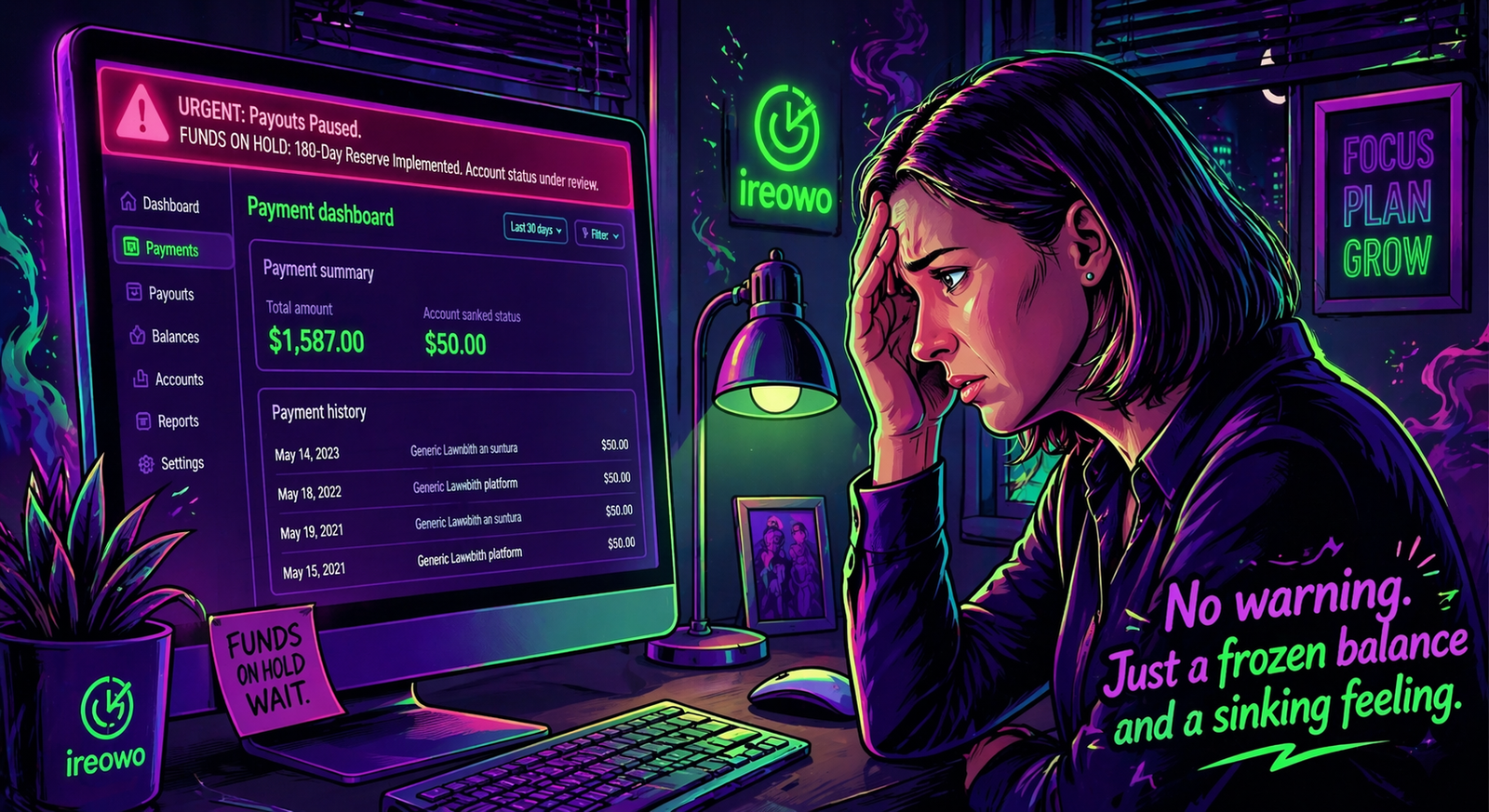
It happens in an instant. You log into your dashboard, and instead of a payout, you see a chilling notice: your funds are on hold. No warning. No clear explanation. Just a frozen balance and a sinking feeling.
This is one of the most common, and most stressful, situations in the payments world. It doesn't only happen with the big names like Stripe, PayPal, or Square. It happens with small processors, obscure aggregators, and offshore platforms too. And in many cases, the business owner had absolutely no idea it was coming.
The good news? Every fund freeze has a reason. And once you understand those reasons, you can build a processing strategy that avoids them entirely.
Let's break it down.
The 180-Day Freeze: The Most Feared Lock in Payments
If your funds have been frozen for 180 days, or you've been told they will be, this is almost certainly because you used a low-risk payment gateway to process transactions for a high-risk business.
Platforms like Stripe are built for low-risk merchants: SaaS companies, e-commerce stores, subscription boxes. They onboard you instantly, no questions asked. But the moment their risk engine detects a pattern that doesn't match their acceptable use policy, they act fast, and hard.
The 180-day number is not arbitrary. It is exactly the maximum window a cardholder has to file a chargeback with their bank. Stripe, or whichever platform froze your funds, is simply holding your money until that window expires, so they aren't left covering disputes on transactions they can no longer reverse.
The brutal reality is: many business owners don't know their business is considered high-risk. Adult content, nutraceuticals, travel, gaming, crypto, subscription billing with high cancellation rates, all of these and more fall under high-risk categories, even if your operations are completely legal and legitimate.
👉 Not sure if your business is high-risk?> Read our full guide: Why Is My Business Considered High Risk?
You can also review Stripe's own list of restricted business categories directly on their Restricted Businesses policy page. Here's what most people don't realize: Stripe does not perform KYC, KYB, or full compliance checks at onboarding. You sign up, connect a bank account, and start processing immediately. Their due diligence kicks in reactively, triggered by anomalies such as: That last one, transaction laundering, is particularly serious and often misunderstood. You can learn more about the regulatory distinction between laws and card scheme rules in our article: Laws vs. Rules in Payment Processing. The European Banking Authority has also published comprehensive guidelines on monitoring for money laundering risk. You can read the EBA's revised AML/CFT guidelines here. 💬 You pay nothing unless approved. High-risk processing is a different world. We live in it. At Ireowo.com, we specialize exclusively in connecting high-risk businesses with licensed European processors who understand your industry, won't freeze your funds at the first sign of volume, and are built to handle the complexity of high-risk compliance from day one. Not every freeze is a catastrophic 180-day lock. A second, more manageable type exists: conditional holds, where your processor pauses payouts until a specific issue is resolved. These freezes often catch merchants completely off guard, because the underlying issue can seem minor, even trivial. But from a legal and compliance standpoint, the processor has no choice. Common triggers include: Your website's T&Cs may be missing mandatory clauses, refund policies, subscription terms, cancellation procedures. European regulations (and card scheme rules) are specific about what must be disclosed. Until those pages are updated and reviewed, your processor cannot legally settle funds. If you operate a platform with user-generated content, your processor may require evidence that you are actively moderating it. This is especially common in adult, social, or marketplace verticals. A screenshot or policy document showing your moderation process is usually enough, but until you provide it, payouts stop. Business licenses, updated corporate documentation, proof of address: processors require these to maintain their own regulatory standing. An expired document can trigger a freeze on your entire account. The good news about conditional freezes is that they are fixable. The bad news is that processors are often vague about exactly what needs to change, leaving merchants guessing while their cash flow suffers. If you're currently stuck in this situation and not sure where to start, drop us your details, we've seen it all and can point you in the right direction quickly. The third type of freeze is financial rather than compliance-based. It happens when: A rolling reserve is a percentage of your daily settlements held back by the processor as a financial buffer, typically 5–10% for high-risk merchants, released on a rolling 90–180 day basis. If your chargebacks or fines exceed what's in that reserve, your payouts freeze until the balance is restored. This type of freeze is the clearest signal that your current processing setup is not correctly aligned with your business model, and that a specialist processor who built the relationship around your actual risk profile would have structured things very differently from the start. Now we arrive at the scenario that can genuinely destroy a business. Not all payment processors operate under proper regulatory frameworks. There is a significant market of offshore aggregators and unlicensed platforms that will happily onboard high-risk merchants that licensed processors won't touch. They charge high fees, make big promises, and seem like a lifeline. Then they freeze your funds, sometimes for 540 days or more, citing vague compliance reviews or risk assessments. By the time that period ends, your business may no longer exist. The funds? They often vanish with the platform. This is not a hypothetical. It is a documented pattern. The legal framework for payment services in Europe is clear: any entity processing payments on behalf of merchants must hold the appropriate authorization under EU law. You can review the relevant EU Anti-Money Laundering Directive (AMLD5) to understand the compliance obligations that licensed processors must meet, and that unlicensed ones are simply ignoring. If your processor is not licensed by a recognized European financial authority, get out. 💬 You pay nothing unless approved. At Ireowo.com, we have made a deliberate choice: we only refer high-risk businesses to licensed European processors with proven track records in high-risk verticals. No offshore aggregators. No shadow platforms. No surprises. We vet every partner in our network so you don't have to. If your business is European and high-risk, you need a processor that specializes in high-risk, not a generic low-risk platform that will freeze you the moment volume picks up. If your business is offshore and you want to process payments in Europe, be aware that most reputable European processors will not take you on without the right corporate structure. The path is harder, but there is a legitimate one. If your business is not fully aligned with both legal requirements and card scheme rules, you are at serious risk of ending up with an unscrupulous offshore processor. And the cost of that mistake will far exceed the cost of getting compliant in the first place. And if you want free, no-commitment guidance, just apply through our platform. We'll evaluate your case honestly, match you with the right processor if we can, and tell you clearly if we can't. 💬 You pay nothing unless approved. Not in law, but in card scheme rules. Visa and Mastercard set the maximum chargeback dispute window at 120 days from the transaction date in most cases (and up to 540 days in rare scenarios). Processors like Stripe use 180 days as their internal standard because it provides a comfortable buffer beyond that window. It's not arbitrary, it's the exact length of time they need to be certain no new dispute can arrive on a processed transaction. In theory, yes. In practice, it is extremely difficult. These platforms have legal teams and automated risk systems, not dedicated account managers for small merchants. Your best leverage is a written appeal that clearly demonstrates your business is now compliant, that your chargeback history is clean, and that any red flags they identified have been resolved. Success rates are low, but not zero. Stripe's risk models are sophisticated. They flag accounts associated with the same business entity, bank account, website, or even device fingerprints. Opening a new account after a freeze or ban is likely to result in an immediate second freeze, and potentially a permanent ban. It also may be considered fraudulent misrepresentation, which carries its own legal risk. Every legitimate payment institution licensed in the EU or EEA must be registered with a national financial authority, the FCA in the UK (pre-Brexit), BaFin in Germany, De Nederlandsche Bank, the Banco de España, and so on. You can verify licensing status on those regulators' public registers. If a processor cannot tell you their license number and regulatory authority instantly, that is a serious red flag. A rolling reserve is a portion of your daily settlements held back as a risk buffer, usually 5–10%, released after 90–180 days. As a high-risk merchant, yes, you will almost certainly be required to maintain one. It is not a penalty, it is how processors manage the elevated risk of working with your vertical. The better your processing history, the more favorable the reserve terms become over time. Absolutely. If a single customer files a chargeback that looks suspicious, or if a cluster of transactions originates from a flagged geography or IP range, your processor may hold funds pending review, even if your own operations are completely clean. This is one of the less-discussed frustrations of payment processing and a strong argument for working with a processor who understands your customer base and has built appropriate risk parameters for your specific business model. Ireowo.com, specialized payment solutions for high-risk businesses. We connect you only with licensed European processors with proven experience in your industry.Why Did Stripe Approve Me If I'm High-Risk?
Conditional Freezes: "No More Payouts Until You Fix X"
Non-Compliant Terms & Conditions
Content Moderation Requirements
Missing or Expired Compliance Documents
Freezes Due to Non-Payment: When Chargebacks Exceed Your Reserve
The Most Dangerous Type of Freeze: Offshore & Unlicensed Processors
In Summary: What You Actually Need to Know
Curious Things You're Probably Wondering