You hired a lawyer. You registered your company. You pay your taxes. By every legal standard, your business is clean.
So why would Visa or Mastercard hit you with a 25,000 euro fine, freeze your funds, and add your name to a blacklist that follows you for up to five years?
Because in the world of online payments, especially high-risk payments, there are two different games running simultaneously: the law, and the rules. Most business owners do not even know the second game exists until they have already lost it.
The Difference Between a Law and a Rule (And Why It Will Cost You)
Here is a simple analogy.
In most countries, you cannot blast music at 3 AM in a residential neighborhood. It disturbs the peace. It is illegal. But a licensed nightclub or concert venue? They can do exactly that, because a specific set of rules governs their environment and creates an exception to the general law.
Now apply that same logic to your business.
Say you own a company with two separate operations: a kitchen supply store and a restaurant. Is there a law anywhere in the world that explicitly says you cannot use the same POS terminal in both locations? Almost certainly not. A judge would look at you sideways for even asking.
But move that same scenario online, and the stakes change entirely.
Two Websites, One Payment Gateway. What Could Go Wrong?
Imagine you have two e-commerce websites. One sells home goods. The other sells something more sensitive: adult products, supplements, firearms accessories, CBD, or online gaming credits. You figure, same company, same bank account, why not use the same payment gateway?
Legally? You are probably fine. Judicially, in most jurisdictions, no court is going to convict you of a crime for routing transactions from two lawful businesses through the same processor.
But Visa and Mastercard do not operate by legal code. They operate by their own internal rules. And those rules are ironclad.
Meet the MCCs: The Classification System That Controls Your Payment Life
Visa and Mastercard assign every business a Merchant Category Code (MCC), a four-digit number that tells the card networks exactly what type of business you are and what risk profile you carry.
Approved for MCC 5651 (clothing store)? Your gateway is calibrated for that risk level.
Now use that same gateway to process sales for a site that should carry MCC 5999 (adult novelties, high-risk retail)? You have just broken the rules, even if every product you sell is 100% legal in your country.
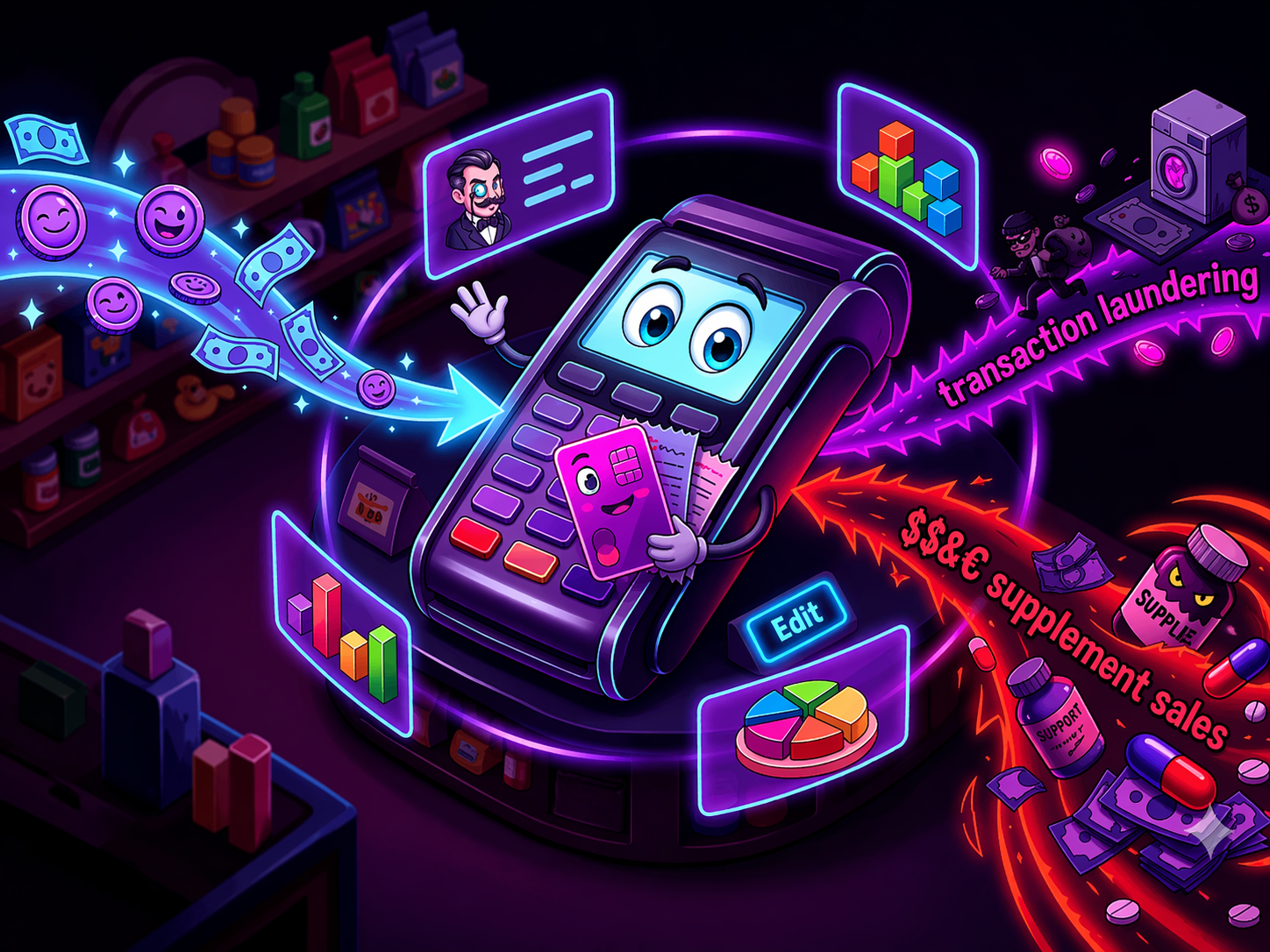
This is the entry point to one of the most dangerous violations in the payment processing world: transaction laundering.
What Is Transaction Laundering?
Transaction laundering (also called cloaking in its most aggressive form) occurs when a merchant approved to accept card payments processes transactions on behalf of another business that was never approved by the card networks.
The unvetted business has skipped every single compliance checkpoint:
- AML (Anti-Money Laundering) screening
- KYC (Know Your Customer) verification
- Risk and compliance due diligence
- MCC classification and risk profiling
Here is the part most business owners miss: even if YOUR business is perfectly legal, bypassing the approval process is itself the violation. It is not the card networks' job to accept your lawyer's opinion that your business is compliant. It is their job, and their right, to determine that through their own vetting process.
Real criminal networks use this exact technique every day. Mixing your legitimate company into that environment is a reputational and legal catastrophe waiting to happen.
📌 Reference: Visa Core Rules and Visa Product and Service Rules
The Consequences Are Not Hypothetical
Visa and Mastercard's monitoring systems are sophisticated, persistent, and they will find you. When they do:
Minimum 25,000 Euro Fine
The card networks do not fine you directly. They fine your payment processor, who then contractually passes the charge to you. Many merchants say they just will not pay. That is not how it works. They will pursue it legally regardless of where you are incorporated.
The MATCH List (Terminated Merchant File)
Your company name, your director's name, your shareholders, and your domain will be added to the MATCH list, also known as the Terminated Merchant File (TMF). This is a shared blacklist maintained by Mastercard and used by virtually every acquiring bank on the planet.
Getting off it can take up to 5 years. During that time, you cannot process online payments. Full stop.

📌 Reference: Mastercard MATCH System Overview, Mastercard Rules Chapter 11
Not sure if your current setup puts you at risk? It takes two minutes to find out. Run your business through our pre-application and we will tell you exactly where you stand before Visa does. You pay nothing unless approved.
Check if your business qualifiesThe Two Most Dangerous Mistakes High-Risk Merchants Make
Mistake 1: Using Low-Risk Aggregators for High-Risk Businesses
These platforms are widely and incorrectly used by high-risk merchants, including adult content platforms, gambling sites, nutraceutical businesses, and CBD retailers.
What happens? These aggregators have sophisticated fraud detection systems. They will identify the mismatch between your approved MCC and actual transaction content. And when they do, they do not just close your account. They report you to Visa and Mastercard directly.
You have just sealed your own fate.
This is cloaking in its most common, accidental form: using a low-risk payment gateway for high-risk or misclassified business activity. The consequence is account termination, fund freezes, and potential MATCH listing.
Mistake 2: Signing Up With a Shady Payment Aggregator
The second trap is subtler and in many ways more dangerous.
Payment facilitators vs. aggregators is a distinction that matters enormously here. A legitimate payment facilitator creates a dedicated processing account (a dedicated MID) for each merchant. A shady aggregator creates one master account and puts all of their clients inside it.
Why does this matter? Because if even one client in that shared account has a bad month with high fraud rates or excessive chargebacks, every other merchant in the account gets dragged into it. You are punished for someone else's problem.
How to Spot a Shady Aggregator
- They do not offer a dedicated MID (Merchant ID)
- They do not allow you to have a custom payment descriptor
- They do not charge a rolling reserve (a legitimate risk management tool)
- Their processing fees are suspiciously high, often 8% to 20%
- They are vague about their licensing or jurisdiction
📌 Reference: European Banking Authority: Guidelines on Payment Service Providers
What a Legitimate High-Risk Merchant Account Actually Looks Like
If your business operates in a high-risk vertical such as adult content, gaming, nutraceuticals, crypto, travel, firearms accessories, or offshore services, you need a high-risk merchant account built specifically for your model.
| Feature | Shady Aggregator | Legitimate High-Risk Processor |
|---|---|---|
| MID Type | Shared | Dedicated MID |
| Custom Descriptor | No | Yes |
| Rolling Reserve | No | Yes |
| Processing Fees | 8% to 20% | 3% to 8% (risk-adjusted) |
| License Jurisdiction | Unclear | EU-regulated |
| MATCH Risk | High | Low |
A dedicated MID means your account is yours alone. Your risk profile is yours. Your chargeback ratios are yours. No one else's bad behavior drags you down.
Why Offshore Businesses Are Especially Vulnerable
Many offshore-incorporated companies struggle to access payment processing in Europe and the United States, the world's two largest consumer markets. Desperate for solutions, they turn to cloaking, shady aggregators, or misclassified gateways.
The irony? This approach makes it harder, not easier, to access legitimate markets long-term. One MATCH listing and you are locked out of EU and US payment rails entirely.
The correct path is the same for every business: find a processor specialized in high-risk, EU-licensed, with dedicated infrastructure for your specific merchant category, and go through the proper compliance channels.
How Ireowo Protects You
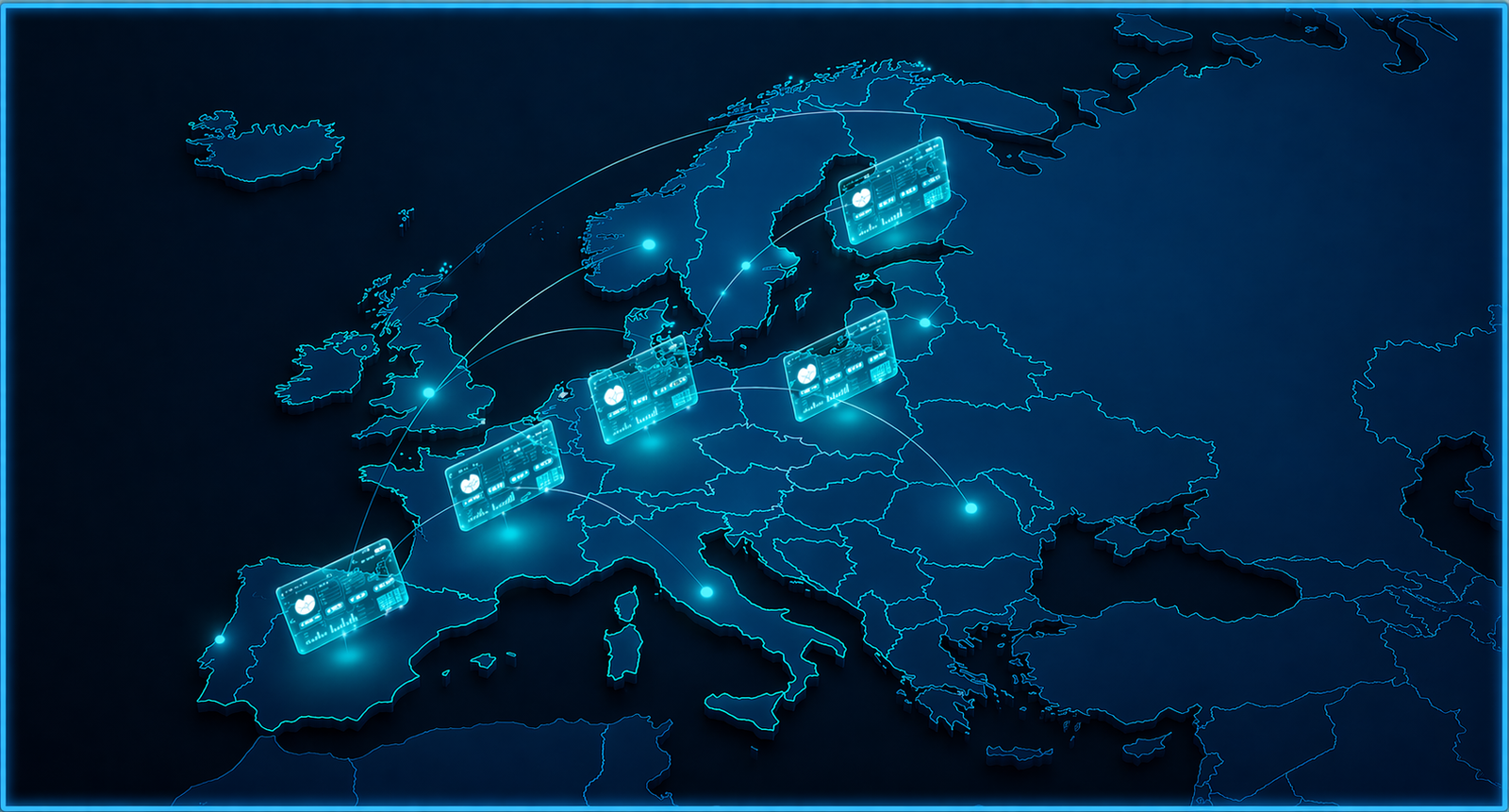
At Ireowo, we work exclusively with EU-licensed acquiring partners that provide:
- Dedicated MIDs so your account belongs only to you
- Proper MCC classification with no mismatches or surprises
- Full AML and KYC compliance so you are never exposed
- Transparent rolling reserves as a sign of a legitimate operation
- Specialization in high-risk verticals because we know your industry
If your business is legal and your operations are structured correctly, we can get you processing without fear of blocks, frozen funds, or processors that disappear with your money.
You pay nothing unless approved
Ready to process payments the right way?
Stop risking your business on the wrong gateway. Let us match you with a dedicated high-risk processing solution built for your vertical: legally, safely, and sustainably.
Start processing payments for your high-risk business todayCurious Things You're Probably Wondering
Visa and Mastercard are private networks. They set their own participation rules independent of national law. Using their network requires agreeing to their terms, which include proper MCC classification and individual merchant vetting. Legal in your country does not automatically equal compliant with card network rules. The two systems operate in parallel and you must satisfy both.
Crypto avoids the card network rules, yes. But it also eliminates access to the vast majority of global consumers who pay by card. Most high-risk businesses need both channels. Businesses that go crypto-only for convenience often signal exactly the kind of risk profile that makes legitimate processors nervous. Crypto is a complement, not a replacement.
In very limited circumstances, typically if you were listed in error, you can petition for early removal. But if the listing resulted from a confirmed rule violation, even an accidental one, removal before the 5-year window is extraordinarily rare and not guaranteed. Prevention is infinitely easier than cure when it comes to the Terminated Merchant File.
It can feel that way. But a rolling reserve, typically 5 to 10% of monthly volume held for 90 to 180 days, is actually a sign of legitimacy. It is a risk management mechanism used by regulated processors. Shady aggregators often skip it entirely because they take their cut through inflated fees instead. A processor charging 15% with no reserve is almost certainly worse for you than one charging 6% with a 6-month reserve. The reserve comes back. The inflated fees do not.
This depends entirely on the processor's jurisdiction and data handling agreements. Another reason why EU-licensed processors matter: they operate under GDPR with legally defined data protection obligations. Processors operating in regulatory gray zones offer you and your customers no such guarantees. A shutdown in an unregulated environment can mean your customers' payment data simply vanishes into an accountability void.
Yes, and that is exactly the point. Criminal organizations use legitimate-looking front businesses, often low-risk merchants, to process payments on behalf of illegal operations. When investigators trace these patterns, any business mixed in, even innocently, gets flagged. Proper compliance documentation and a dedicated MID are your strongest defense against being caught in that net. The structure of your payment setup is, in itself, a legal protection.
More deep dives are coming. In future articles we will go further into chargeback ratios, rolling reserve structures, and exactly how to read a merchant processing agreement before you sign it. Follow Ireowo for the knowledge your payment processor hopes you never find.